On the first of November, Mom and I decided we should go to Tsukiji and get in on some of the fish market action that takes place there. Since the most exciting part-- the tuna auction-- is apparently closed to the public (and is at 5am anyway), we decided just to wander around the gigantic market and eat lunch afterward.
We left Fussa around 9 in the morning. Although our original itinerary said to get off the Chuo Line at Yotsuya Station and switch to the subway from there, Mom thought that it'd be better if we got off at Tokyo Station and jump on a line bound for Hatchoubori, and then from there take the Hibiya subway line to Tsukiji Station. I don't think we saved any time or money, but it was an experience, trekking down, down, down, and down farther still in Tokyo Station until we reached the Keiyo Line platform. From there it was only one stop to Hatchoubori, and from Hatchoubori it was only one stop on the Hibiya subway line to Tsukiji. It was a tiny station, and the bathroom was yucky. I wasn't surprised.
Around the corner from the station was the Tsukiji Hongwanji, a rather large and very South Asian-styled Buddhist temple. The architecture was fascinating, and the inside was even more ornate than the outside. It reeked of incense, and Mom and I at first thought we had stumbled upon the latter half of someone's funeral. When we exited, we noticed that volunteers were busily packing welcome bags for an appreciation ceremony to take place later for rich people who contributed large sums of money to a local dentistry college. We didn't feel bad after that point.
Mom wanted to check out a museum that supposedly had exhibits with information on the fish market. Luckily it was right next to the market and we didn't have to go out of our way to find it because it turned out to be a single room with books and pamphlets on fish and maps to guide you through the different vendors in the market. It was a little disappointing, but we went ahead to the market itself.
Tsukiji's fish market is huge. Imagine, if you will, the largest warehouse you have ever seen, and multiply it by like, 5 or something. I may be exaggerating, but it's pretty dang huge inside, and it houses dozens (hundreds maybe?) of vendors. We arrived a bit before noon, when the market had died down and all the fish mongers were packing up to leave. It was still busy, still full of tourists, and many vendors were still selling fish (amongst other, less fish-like denizens of the deep). The alarming thing, though, was that through the narrow corridors zoomed guys on bicycle-powered carts, three-wheel motorbikes, and heavy-duty motorized carts that were probably zipping by at 15 miles an hour on the wet, fishy floors. It's not a place for casual tourists with large backpacks overflowing with Naruto posters and rolling luggage-- it's a place of srs bznss where restaurateurs and grocery sellers buy their fresh fish for the day, or for Average Joe to get a good price on his tuna steak dinner. Etiquette prevails at the market, and Mom read on the Japanese site that you shouldn't haggle prices with the fish mongers, as it's seen as being disrespectful and rude, challenging the price that an experienced fisherman places on his catch. "Can you make this cheaper?" is equivalent to calling him a liar, and may get you booted out of his 3x5 space with many harsh words following you.
After dodging carts, puddles, and tuna carcasses, Mom and I decided that looking at thousands of dead fish on ice in various states of dismemberment made us hungry for the real thing. We headed to the restaurant area where, even hours after they had opened, there were lines flowing out the doors to get the freshest of the day's catch for lunch. We were surprised at how popular the non-fish places were. Bafflingly, katsudon and ramen shops had the same humongous lines. We shrugged, and waited for a random place to seat us. Luckily, we only waited about 20 minutes or so for a table. Not too bad, considering people claimed to have waited for hours to get a seat at Tsukiji restaurants.
We chose a place called うまい鮨勘 (Umai Sushikan), which literally means "Tasty Sushi Sense." We were sat on the sushi bar, which Mom disliked, but I enjoyed watching the chefs work their magic by quickly squeezing together the nigiri balls and slapping the freshly-sliced fish on top, all at breakneck speed, and all while calling out "Welcome!" and "Thank you!" and glancing down at tiny hand-written orders. I got a plate with some variety, from tuna and salmon to scallop and roe. The egg was cute. While I usually don't care much for egg, this one had "うまい鮨勘" stamped on the side. That was a nice touch. The miso soup, however, was something I did not enjoy even slightly. It was made with fish scraps and tasted exactly like hot ocean brine with thin bones and vegetable particles floating in it. Mom drank both our bowls. I couldn't stomach it.
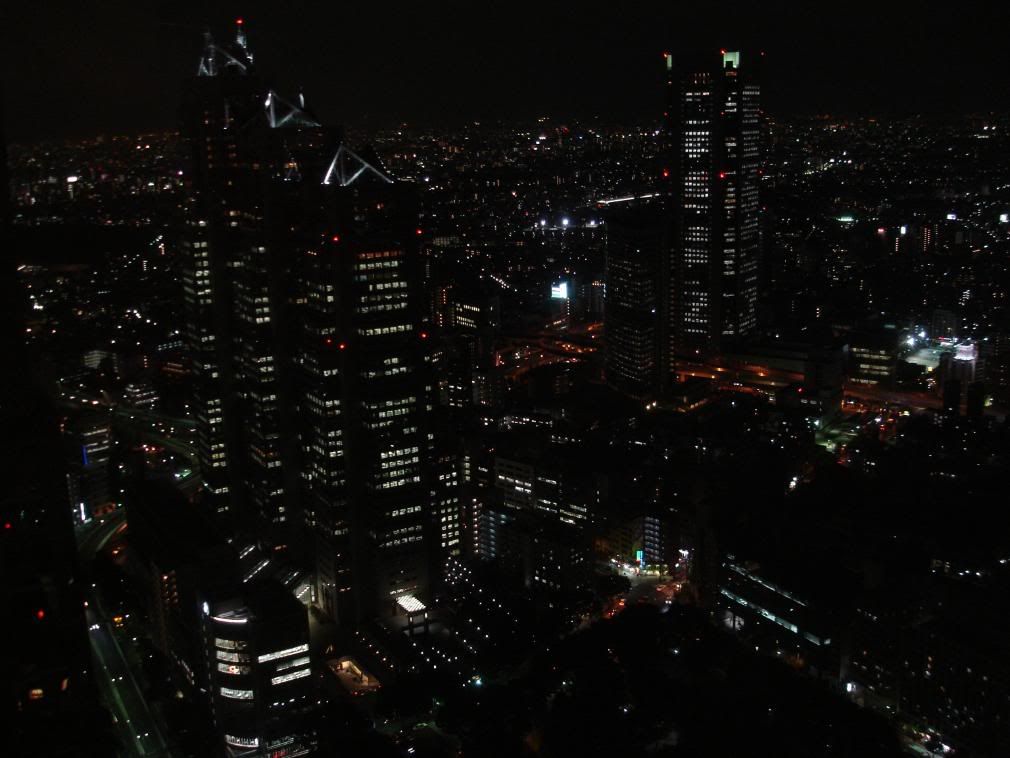
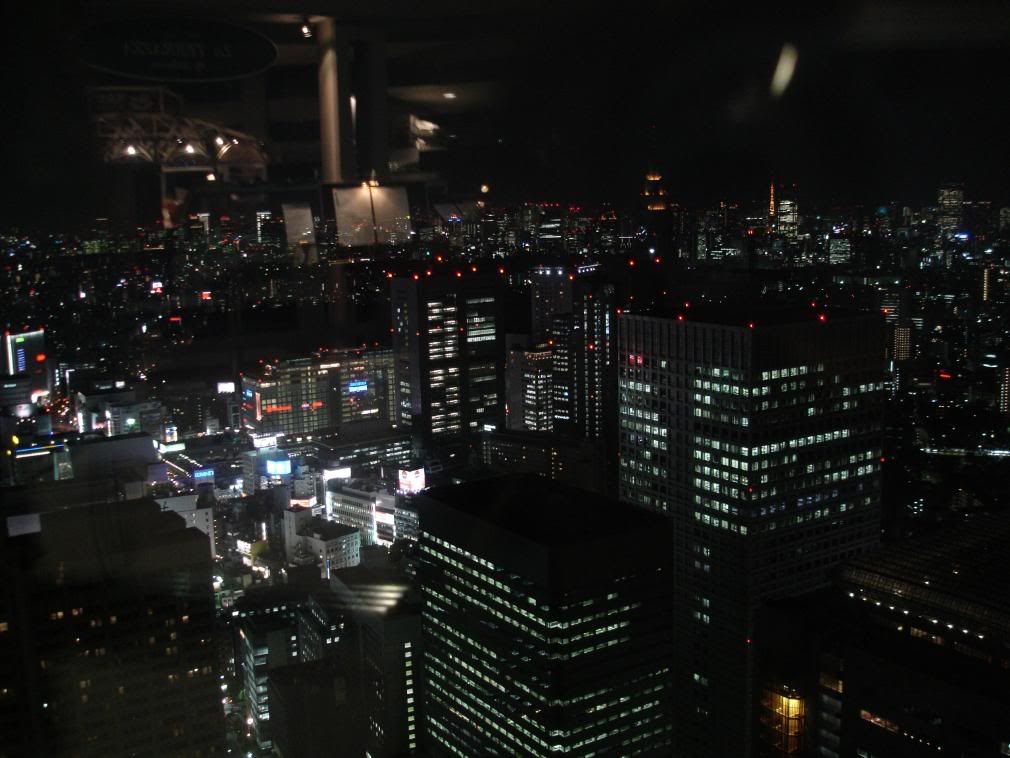
Mom had left her denim jacket at the library the previous day, so I lent her a long-sleeved shirt to wear for the day. Apparently she really wanted to lose my shirt, too, because she left it in the restaurant. Luckily we realized it was gone minutes after leaving the place, so we ran back and retrieved it. We briefly visited a small shrine just outside the fish market area and headed to a hospital where they had a free observation deck on the 47th floor. It was extremely warm, but the view was great. Mom rested her feet for a while as I took lots of pictures out the windows. She asked a lady for directions to the nearest JR station, and out we headed.
We walked through Ginza on our way to the Yuurakucho station. Although it's a shopping mecca, I wasn't impressed by the street we walked along. It was mostly office buildings with young men in suits, squatting on the sidewalk while smoking and chatting on their cell phones-- an odd sight, indeed. Just before the station, I was distracted by a troupe of girls doing a traditional drum performance outside of a newly-opened pachinko hall. I stopped to take video of them-- it was impressive how much energy they had. My arm was getting tired just holding the camera, and here they were jumping up and down beating enormous drums strapped over their shoulders. Crazy.
We hopped on a line bound for Ueno, as Mom wanted to walk from there to Asakusa. We briefly stopped in Ameyoukocho, an alley full of small shops and street vendors peddling cheap wares, to ask for directions before taking the very long and somewhat painful walk to Asakusa. It took us almost an hour to get to the Kaminarimon, which is the gigantic red lantern that welcomes you to the street where all the vendors set up shop. The road we took to get there was lined with stores specializing in 仏壇 (butsudan), which are altars for deceased family members. It was extremely creepy, and it was obvious that that part of town was probably aging and full of a lot of old people on the verge of kicking the bucket.
When we finally reached Kaminarimon, evening was rapidly approaching and we only had maybe an hour or two of sunlight left. The first vendor we came across on Nakamise (the road where all the peddlers set up shop) was selling fresh-made red bean-filled ningyoyaki, which is a small cake made of flour and egg. molded into shapes. We bought two bags to take home to Obaachan and a bag of hot ones to eat while we walked. The people selling them were exceedingly brusque, which totally surprised us. All of the vendors were loud, rude, and pushy, and I couldn't help but be reminded of dirty carnies in America. I felt this whole street was a giant tourist trap, and Mom agreed. We kept snagging samples at the osembe shops, and Mom deliberated on whether or not to buy a bag. She ultimately decided against it, as they were quite expensive (as were all the other things on that street). The ningyo were cheap, at least.
We visited the temple at the end of Nakamise, called Sensoji. It's the oldest temple in Tokyo and is something like 1500 years old. Plenty of people were milling about, clothing statues, washing their hands at the entrance, tossing money into the offering bins and praying. Prayer rituals are serious business in Japan, and people had some elaborate arm gestures and bowing maneuvers carefully choreographed to achieve maximum levels of Buddha-pleasing. It was impressive.
As the sun began to dip down, Mom and I discussed what we would do for dinner, as we hadn't eaten since lunch many hours previously, and although we weren't starving we figured we should eat something. We wandered around Asakusa looking for a good deal on food, but decided that perhaps Shinjuku might offer something better. Instead of walking back to the JR station in Ueno we hopped on the subway and took it back to Ueno station where we got onto the Yamanote heading south where we expected to switch to the Chuo line back to Shinjuku (the reason being that Tokyo is the terminus for the Chuo line and we'd be guaranteed a seat). However, since we were able to get a seat on the Yamanote in Ueno, we rode it the whole way to Shinjuku, even though it was like taking a route that went around 3 sides of the square. We didn't mind, and welcomed the rest.
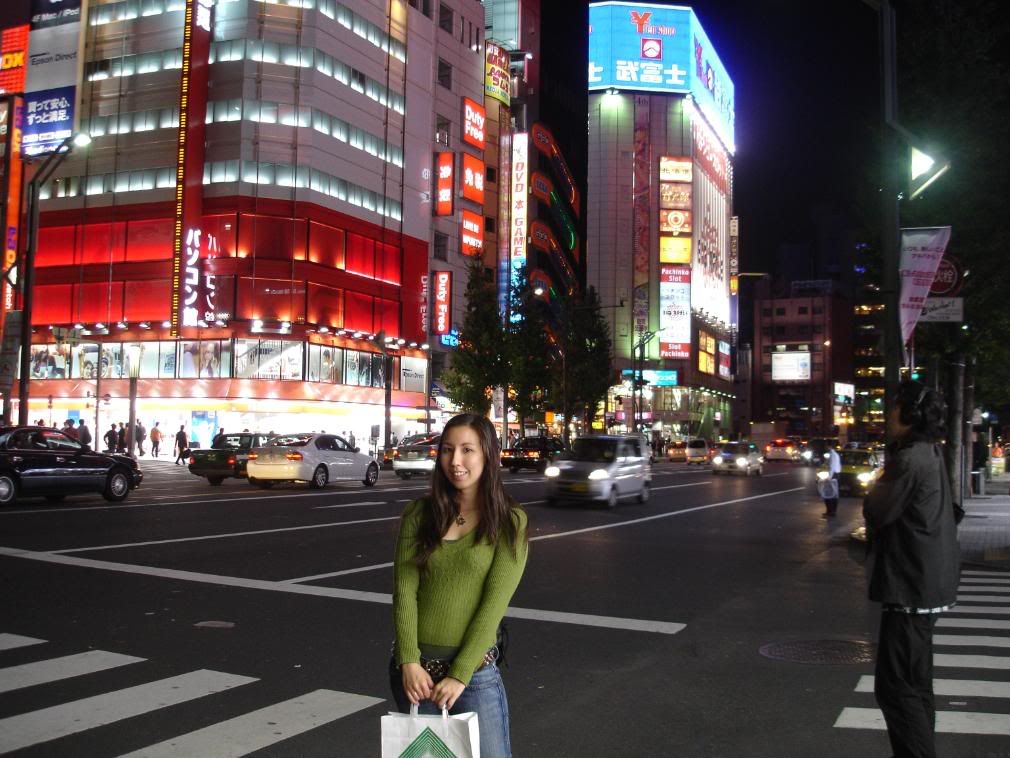
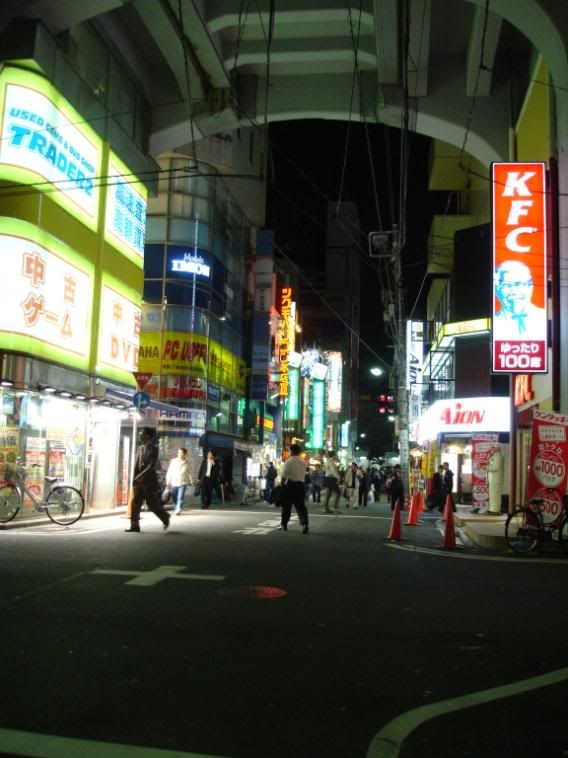
When we got into Shinjuku, it was packed with people, like usual. We went into Kabukicho to look for a restaurant and ended up wandering for almost an hour, unable to find any place that was both inexpensive and tasty-looking. We did see a trio consisting of a drummer, a saxophone player, and a guy holding a banner for a bar; they were playing "Izakaya," a kayoukyoku song about a man trying to pick up a girl at a plain, generic bar ("There's no pictures, no flowers, no music, no words, no jokes or anything to decorate this kind of bar"). It was cute. We also saw advertisements for host bars full of tanned, bleached, airbrushed young men who would be more than happy to let you buy them expensive alcohol and food to fulfill your sad, lonely office lady life.
We got lost looking for the Isetan, tempted by its purportedly abundant food basement, and although we found it, it was close to closing time, so we sampled milk and tofu, pickles and salad dressings, weighed the benefits versus the costs of some of their produce, and ultimately left with nothing. We caught the train at Shinjuku station and headed back to Fussa. When we arrived, we had enough time to peruse the deals at the Ozam before they closed for the night. There we picked up dinner-- fried oyster bento box, korokke, and gyoza, all at half-price. We enjoyed our dinner at home, and although it was late and we were tired, it was oh-so satisfying (and probably a lot better than anything we could have picked up for 4 times the price at a normal restaurant). It was a fun-filled day, and exhausting because of all the walking we did.